






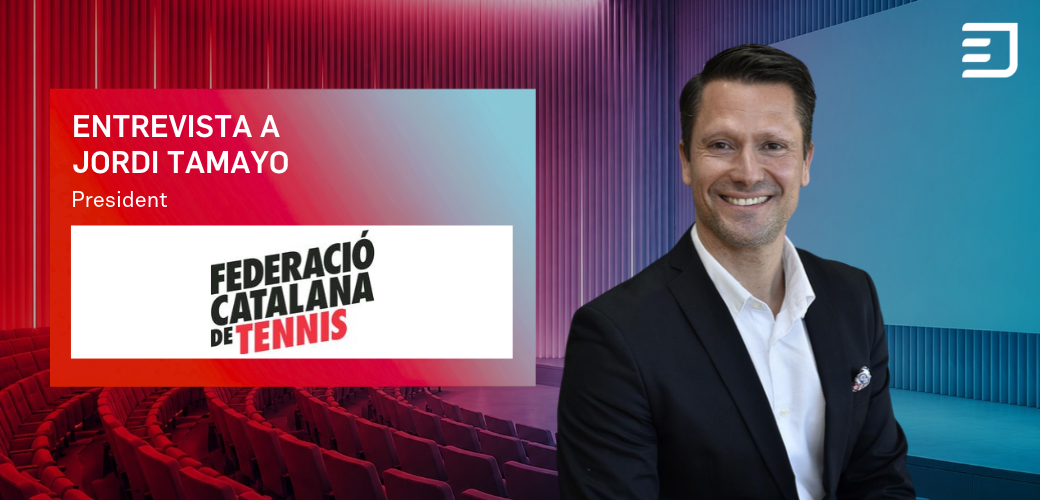
How is Catalan tennis preparing to tackle the challenges of the future? The Catalan Tennis Federation is committed to innovation, sustainability, talent development and internationalisation to continue growing a sport with a rich tradition and strong prospects. In this interview with Jordi Tamayo, President of the Catalan Tennis Federation, we explore the Federation’s vision for the future, its key projects and how collaboration between clubs, companies and the sports industry can turn sector challenges into new opportunities for growth.
Catalan tennis has a long sporting tradition and an established presence across the region. What is the role of the Catalan Tennis Federation today, and what are the main challenges you have set yourselves to continue growing the sport?
Catalan tennis has an extraordinary history and a very exciting future. Catalonia has a network of clubs with a strong presence throughout the region, a long-standing tradition of player development and an organisational capacity recognised internationally. It is one of the world's leading tennis regions.
At the Catalan Tennis Federation, we understand and believe that we must be a tool serving clubs, athletes and the sector as a whole, helping to create the conditions needed to continue driving Catalan tennis forward.
As a Federation, we face a number of major challenges. The first is to ensure that the Federation remains financially sustainable. During our term, we have managed to make the organisation sustainable through its ordinary activities, paying off the debt of more than €6 million that the Federation had when we took office in 2017. The second is to support clubs and help them with whatever they need. The third is to broaden the base of people playing tennis, both among young people and senior audiences. Finally, we want to continue positioning Catalonia as an international benchmark for hosting competitions and developing tennis.
Projects such as Clubs d’Excel·lència, the transformation of our competition circuits and the organisation of international tournaments are all part of this vision.
Beyond high-level competition, tennis is an activity linked to health, education, social interaction and healthy lifestyles. How can we make the sport even more accessible to new audiences and encourage more people to play throughout their lives?
One of tennis's greatest strengths is that it is a sport people can play throughout their lives. From childhood to a very advanced age, it offers physical, emotional and social benefits that go far beyond competition.
That is why one of our objectives has been to challenge the perception that tennis is exclusively a competitive sport or difficult to access. We have succeeded in encouraging more and more people to see it as a healthy, social activity.
In this respect, we believe it is essential to strengthen the connection between clubs and their local communities, bringing tennis to where people are. School outreach initiatives, street tennis activities and introductory tennis programmes are essential tools for reaching new audiences.
We are also working to expand opportunities to play through disciplines such as pickleball and beach tennis. These complement the sporting offer and allow us to connect with different groups of people.
And, of course, we must continue promoting inclusive tennis, adapted to different abilities and personal circumstances.
The major challenge is to ensure that anyone who discovers tennis has opportunities to keep playing throughout their life, regardless of age, skill level or motivation.
The sports industry is undergoing profound transformation driven by technology and innovation. How is tennis evolving in areas such as digitalisation, data analysis, training methods and improving the experience of participants?
Technology is profoundly transforming the sports sector, and tennis is no exception, both in sporting activities and in management. Today, we have tools that make it possible to analyse players' performance, personalise training, prevent injuries and improve the experience of participants.
At the Federation, we are moving forward with the modernisation of our digital processes and services, with the aim of making it easier to work with clubs, simplifying competition management and improving federated members' access to information.
We are also convinced that data analysis must play an increasingly important role in decision-making. A better understanding of players' habits, clubs' needs and participation trends allows us to design more efficient sports policies tailored to the habits and needs identified through this analysis.
Technology must also play a key role in training coaches and technical staff, providing new methodological opportunities and ensuring that professionals have the knowledge they need to make the most of them.
In short, innovation must be a tool for improving services and making our sport more efficient.
Sports organisations must respond to new needs and consumption patterns while ensuring their financial sustainability. What are the main management challenges currently facing tennis federations and clubs?
Tennis clubs are facing a particularly demanding period. Rising maintenance and energy costs, the need to upgrade facilities and changing sports consumption habits are forcing them to evolve their management models.
Historically, many clubs have done extraordinary work thanks to the commitment of their boards and teams. Today, however, that alone is no longer enough. Clubs now need to plan strategically, diversify their income, implement member-retention initiatives and adapt their offer to meet members' changing demands.
It was precisely with this in mind that we launched the Catalan Tennis Federation's Clubs d’Excel·lència project. It recognises clubs that meet specific standards and provides them with a framework of support, services and benefits to help them continue improving.
It is also essential to evolve the way we work with businesses. Sponsorships must become more than financial contributions linked to brand visibility: they need to develop into partnerships that create real value for all parties.
At the Federation, we want to support clubs throughout this process by providing tools, training, shared services and opportunities for collaboration.
Attracting and retaining talent is essential to the future of any sport. What needs to be done to develop sporting talent from grassroots level while also attracting and retaining the professionals who make clubs and organisations work?
When we talk about talent, we often think exclusively of players. However, we want the concept of talent to include coaching teams, fitness trainers, referees, managers and all the professionals who make the day-to-day activities of clubs possible.
In terms of sporting talent, Catalonia has a network of clubs and schools that represents an extraordinary asset. We also support a model that combines grassroots competition, player development, training and collaboration between clubs and the Federation. Initiatives such as the Reference Centres, meetings with other regional teams and development circuits help us retain young tennis players.
But we must also focus on professional players, because they are role models for young people and inspire many others to take up the sport.
We must also recognise the value of the professions linked to tennis, continuing to offer training pathways and creating opportunities for professional development in clubs across Catalonia.
We are clear that, if we want outstanding athletes to look up to, we need outstanding professionals supporting them in every area. This is a shared responsibility between federations, clubs and institutions.
Equal opportunities and the visibility of women's sport are becoming increasingly important issues across the sector. What progress has been made in tennis, and what opportunities remain to further promote women's participation, leadership and visibility?
Tennis has historically been one of the pioneering sports in promoting and recognising women's sport. But that does not mean we have achieved all our goals. There is still much work to be done, particularly when it comes to women's representation in coaching, officiating and leadership positions.
At the Catalan Tennis Federation, we believe equal opportunities must be part of all our sports policies, from introductory programmes through to elite competition.
One of the projects that best represents this commitment is the Catalonia Open WTA 125, an international women's tournament that we conceived as a travelling event, bringing professional tennis to different cities across Catalonia.
Our aim is for the tournament to be more than just a major competition: it should create a sporting and social legacy in the region. We want girls to have the opportunity to see the best players up close, clubs to use the event to encourage greater female participation, and cities to see tennis as an opportunity to promote sport.
We must also continue working to increase the number of women coaches, referees, managers and leaders.
Equality is not simply about offering the same opportunities. It also means identifying and removing the barriers that still make it difficult for women to access and remain involved in sport.
Sustainability is an increasingly important challenge for sports facilities, from environmental, economic and social perspectives. How can we move towards a more sustainable, efficient and accessible model for tennis clubs and facilities?
Sustainability is no longer an option; it is a necessity if we are to secure the future of our clubs. And when we talk about sustainability, we must take a broad view: environmental, economic and social.
Tennis faces specific challenges in this area, particularly in terms of water consumption, facility maintenance, energy efficiency and waste management.
For years, the Federation has been working in this direction through our Sustainability Plan, which includes initiatives related to the circular economy, material recycling, reducing single-use materials and working with environmentally responsible suppliers.
A specific example is our collaboration with Greencourt to promote clay-court solutions that reduce watering requirements and optimise court maintenance.
We also lead European projects such as Erasmus+ B4SS, which aim to develop tools to help sports organisations understand and improve their environmental impact.
But sustainability also means ensuring that clubs are financially viable and socially accessible.
I believe the key is to make knowledge, new technologies and shared solutions more accessible to clubs. Sustainability should not be an additional burden for clubs, but an opportunity to improve their efficiency and competitiveness.
Based on your experience leading the Federation, what lessons can we learn from the leading international tennis management models, and which approaches do you think would be most valuable to adopt in Catalonia?
Being a member of the World Tennis Board and First Vice-President of the Royal Spanish Tennis Federation allows me to gain first-hand insight into different sports development models and share experiences with federations from around the world.
Every country has a different social, economic and sporting context, so there is clearly no single model for success. However, organisations that manage to grow tennis sustainably do share certain common features. These are precisely the elements we need to analyse to see whether they can be adapted to our own circumstances.
One thing we are very clear about is that we work with a long-term strategy that goes beyond electoral cycles. Our responsibility is to secure the best possible future for the institution, with clear and measurable objectives.
It is also essential to establish a strong connection between grassroots sport and high performance. Countries that achieve good sporting results tend to have solid development structures and clearly defined pathways for athletes.
The third key element is the ability to innovate and build partnerships with businesses, educational institutions and public administrations.
In this respect, I believe Catalonia has a major strength: its network of clubs. It is a unique membership-based model with a strong tradition that we must preserve.
I also believe we have a great deal to offer. Catalonia has demonstrated a strong ability to organise international competitions, develop athletes and create sporting projects that connect clubs with their local communities. We must be ambitious enough to keep learning while also becoming a benchmark for other federations.
How can tennis, businesses and sports industry stakeholders work more closely together to open up new markets and generate business opportunities internationally?
Tennis is much more than a sporting activity. It is supported by an entire industry encompassing equipment, technology, facility construction and maintenance, training, sports tourism and event organisation, among other areas.
Catalonia has highly competitive companies in many of these fields, as well as a sports ecosystem with significant international reach.
At the Federation, we believe we can act as a connecting point, creating spaces for collaboration and helping generate new opportunities.
One example is the agreements we have developed with companies such as Wilson and Greencourt. These allow us to move beyond traditional sponsorship and explore projects linked to clubs, athletes and the development of tennis.
I also believe major sporting events are extraordinary platforms for internationalisation. Competitions such as the Catalonia Open WTA 125 and the Wheelchair Finals help promote Catalonia internationally and create opportunities for companies connected to the sports industry.
The international growth of Catalan tennis should also create opportunities for companies in our sector to expand internationally.
The Catalan Tennis Federation is a member of INDESCAT, the Catalan sports industry cluster. What does being part of this ecosystem bring to the Federation, and how can collaboration between sports organisations and businesses help address the challenges facing the sector?
Being part of INDESCAT allows us to broaden our perspective and understand that the challenges facing tennis are, in many cases, shared by the sports industry as a whole.
Federations and clubs have first-hand knowledge of the needs of participants and sports organisations. Businesses, in turn, bring innovation capabilities, technology, specialised knowledge and new solutions.
When we connect these two worlds, very interesting opportunities emerge.
For us, that is precisely the value of INDESCAT: providing a space for meeting, knowledge exchange and collaboration between stakeholders who, despite working in different fields, share the goal of growing the sports sector.
I believe there is particularly significant potential in areas such as club digitalisation, facility sustainability, professionalising management, training and developing new products and services.
We must also be able to turn clubs' real needs into innovation opportunities for Catalan businesses. Clubs can serve as environments in which to test new solutions, validate technologies and develop projects that can subsequently be rolled out in other markets.
Collaboration between sport and business must move beyond a sponsorship relationship and become a genuine strategic partnership.
And INDESCAT can play a very important role in this process by connecting the entire ecosystem.
Looking ahead to the next five years, how do you envisage the future of tennis in Catalonia? What changes or opportunities do you think will shape the sport's development, and what goals would you like to have achieved?
I believe the next five years will be shaped by significant changes. Digitalisation, the integration of AI into our daily lives, new sporting habits, sustainability and the evolution of management models will require federations and clubs to keep adapting.
But we also have major opportunities.
We want to consolidate a club model that combines the tradition of membership-based organisations with innovation. We want to continue expanding the number of people playing tennis, particularly children and young people, and make tennis an activity that accompanies people throughout their lives.
We want to strengthen our talent development model and continue our firm commitment to women's tennis.
Internationally, we are ambitious about continuing to grow the Catalonia Open and establishing Catalonia as a host destination for major competitions. But with one very clear principle: major events must leave a real legacy for clubs, cities and the region as a whole.
And, of course, we want to continue developing new sporting opportunities through pickleball and beach tennis, which can help expand the racket sports community.
If, in five years' time, we have more people playing, more clubs with the capacity to grow, more highly trained professionals and Catalan tennis with even greater international recognition, we will have done a good job.
Because our success should not be measured solely by the victories we achieve, but also by the opportunities we are able to create.